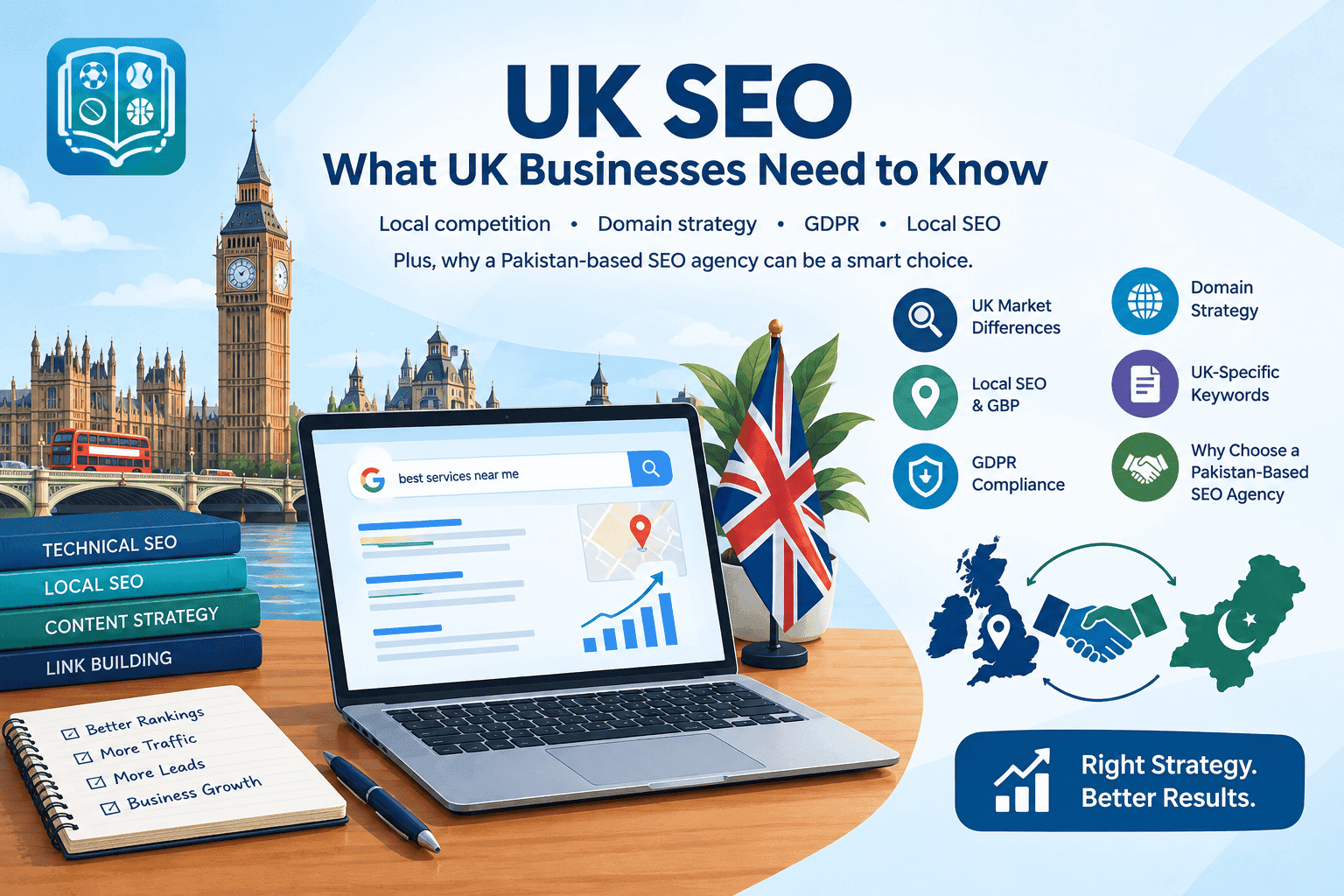
SEO for UK Businesses: Why Outsourcing to a Pakistan-Based Agency Works (2026)
September 23, 2026Read Post
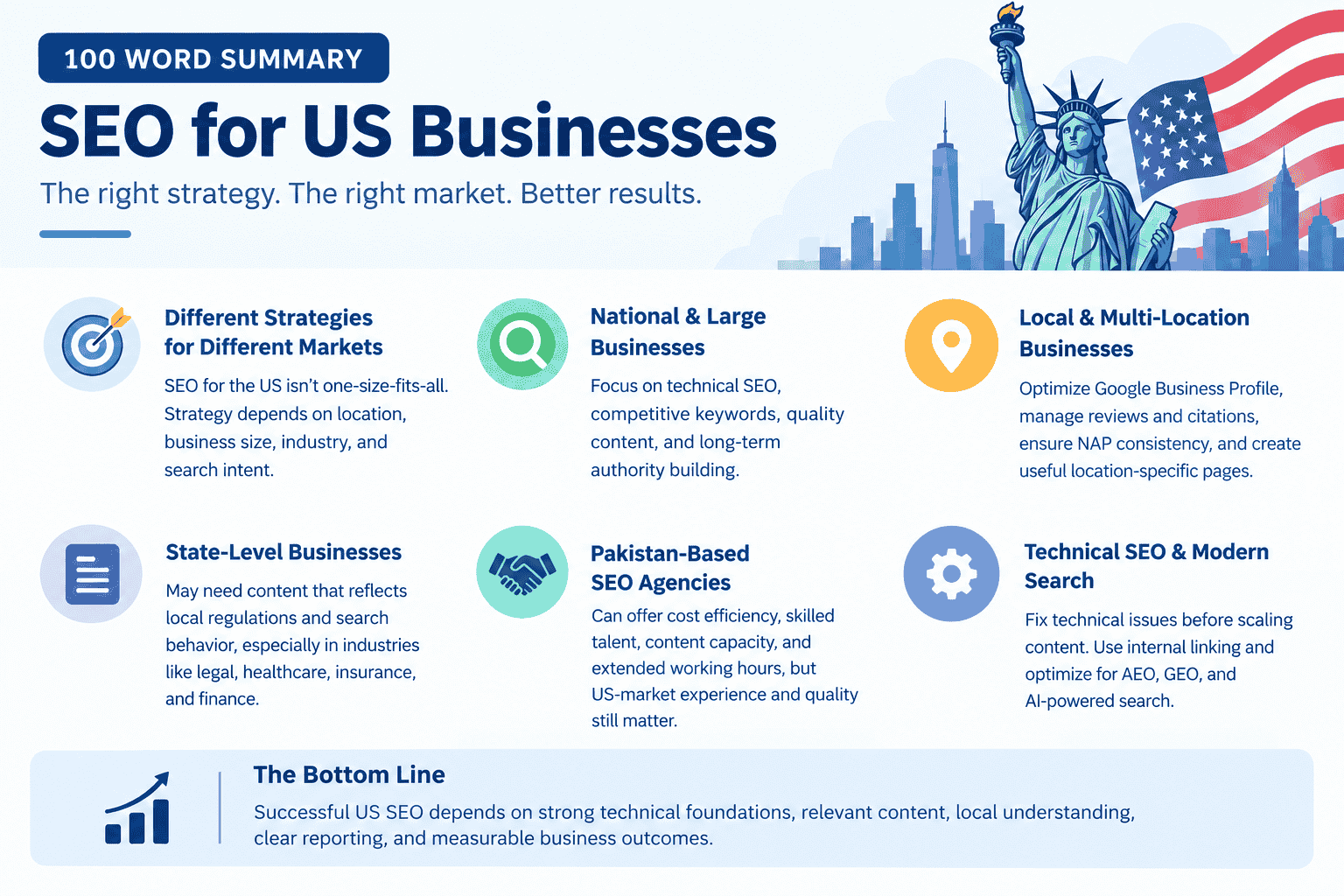
SEO for US businesses requires different strategies based on location, business size, industry, and search intent. National businesses should focus on technical SEO, competitive keywords, quality content, and authority building. Local and multi-location businesses need Google Business Profile optimization, reviews, citations, NAP consistency, and useful location-specific pages. State-level businesses may also need content that reflects local regulations and search behavior. Pakistan-based SEO agencies can offer cost efficiency, skilled talent, content capacity, and extended working hours, but US-market experience and quality remain important. Strong technical SEO should come before scaling content. Modern US SEO also includes internal linking, AEO, GEO, and AI-powered search.
The US is not one search market it's dozens of overlapping ones, differing by state, city, and industry. A strategy that works for a local plumber in Ohio looks nothing like one built for a nationwide SaaS company.
Here's how to think about SEO for a US audience properly, whichever end of that spectrum a business sits on.
National/enterprise SEO competes for broad, high-volume keywords against large, well-established competitors. Success here depends heavily on domain authority, content depth at scale, technical SEO, and sustained authority building over a long timeframe.
Multi-location and franchise SEO requires managing consistent, locally relevant pages and Google Business Profiles across dozens or hundreds of individual locations without them competing against each other or reading as duplicated content.
Single-location local SEO looks closer to local SEO anywhere else Google Business Profile optimization, local citations, reviews, and location-specific content but within US-specific competition levels and directory ecosystems.
Getting the scale right at the start prevents building a strategy designed for the wrong kind of competition.
Cities like New York, Los Angeles, Chicago, Houston, and other major metropolitan areas have extremely competitive SEO landscapes across many industries.
Smaller cities and regional markets can have very different competitive conditions.
This means geography-based strategy matters significantly for US SEO.
A business targeting one city shouldn't automatically use the same keyword and content strategy as a company targeting the entire United States.
Industries like legal services, healthcare, insurance, and financial services can require state-specific content because regulations, terminology, and customer expectations may differ between states.
A single generic national page may therefore not be appropriate for every business or industry.
For businesses operating across multiple states, SEO strategy should consider state-specific search intent and genuinely useful local information rather than simply creating near-identical pages with different state names.
Beyond Google Business Profile, the US market has a large ecosystem of review platforms, business directories, industry-specific websites, and local resources.
For local businesses, maintaining accurate business information across relevant platforms can therefore be an important part of the overall local SEO process.
For businesses serving specific cities or geographic areas, Google Business Profile optimization should be part of the local SEO strategy.
This includes maintaining accurate:
Business information
Categories
Services
Opening hours
Website information
Business description
Reviews
Competition for map visibility can be particularly strong in major US metros, making ongoing optimization more important than treating the profile as a one-time setup.
Name, address, and phone number consistency becomes more complicated when a business appears across a large directory ecosystem.
Businesses with multiple locations should maintain a consistent system for managing location information across relevant platforms.
Multi-location and service-area businesses may benefit from location-specific pages when those pages provide genuinely useful local information.
A strong city or state page can include:
Local services
Service-area information
Local customer needs
Relevant FAQs
Location-specific proof
Unique business information
Appropriate internal links
The goal should not be to create hundreds of pages that differ only by replacing one city name with another.
US businesses increasingly have the option of working with international SEO teams, including agencies based in Pakistan.
The practical reasons can include cost structure, access to specialized talent, content production capacity, and extended working hours.
However, outsourcing should not mean lowering standards.
A professional SEO partner should still provide:
Experienced SEO specialists
Technical SEO expertise
Quality content
Transparent reporting
Clear strategy
Reliable communication
Measurable KPIs
US-market understanding
RankNex AI specifically provides digital marketing and SEO services for US businesses, including SEO, PPC, AEO, GEO, and related digital services.
You can learn more about the dedicated RankNex AI US digital marketing services.
Pakistan has a growing pool of digital marketing and SEO professionals.
For some US businesses, outsourcing can provide access to experienced specialists at a different cost structure from hiring an equivalent team in the United States.
Lower cost, however, should not mean lower standards.
Before hiring an international SEO agency, evaluate:
Previous US campaigns
Technical capability
Content quality
Reporting standards
Communication
Strategy
Measurable results
The agency's location should be only one part of the decision.
Time-zone differences can also provide operational advantages.
A properly managed international team can continue working while a US business is outside its normal working hours.
This can help maintain progress across:
Content production
Technical SEO
Competitor research
Reporting
Campaign management
Website updates
The arrangement works best when communication processes, deadlines, responsibilities, and approval procedures are clearly defined.
English-language capability is important when producing content for US customers.
However, fluent English by itself is not enough.
US-focused content should understand:
American terminology
US search behavior
Local search intent
Commercial expectations
Industry-specific language
Competitive search results
The finished content should feel relevant to US customers rather than like generic international SEO copy.
Ask potential agencies for examples of previous campaigns involving US businesses or US search markets.
Useful evidence can include:
Organic traffic growth
Keyword improvements
Local visibility
Leads generated
Technical improvements
Content performance
Ideally, the examples should be relevant to your industry, business size, and target geography.
A strong SEO partner should understand the difference between:
National SEO
State-level SEO
City-level SEO
Local SEO
Multi-location SEO
Service-area SEO
The strategy should reflect the actual geography of the business.
If a company operates across multiple locations, ask how the agency prevents location pages from becoming duplicate or thin content.
Every location page should exist for a genuine search and customer need.
The agency should establish:
Meeting schedules
Reporting dates
Response expectations
Approval processes
Emergency communication procedures
Clear communication is more important than simply being located in the same country.
Competitive US SEO campaigns can involve large amounts of content.
But publishing hundreds of pages won't solve fundamental technical problems.
Before scaling content, review:
Crawlability
Indexability
XML sitemaps
Canonical tags
Redirects
Internal linking
Mobile usability
Page performance
Structured data
Site architecture
If important pages aren't appearing in Google, investigate why pages aren't getting indexed on Google before significantly increasing content production.
US SEO content should be based on actual search intent rather than simply producing articles containing American keywords.
A strong content system can include:
National service pages
State-specific pages
City pages
Informational guides
Comparison content
Industry resources
FAQs
Supporting blog content
These pages should then be connected through relevant internal links.
For example:
US SEO guide → Local SEO guide → City page → Service page → Conversion page
This creates a logical journey for users while strengthening relationships between relevant pages.
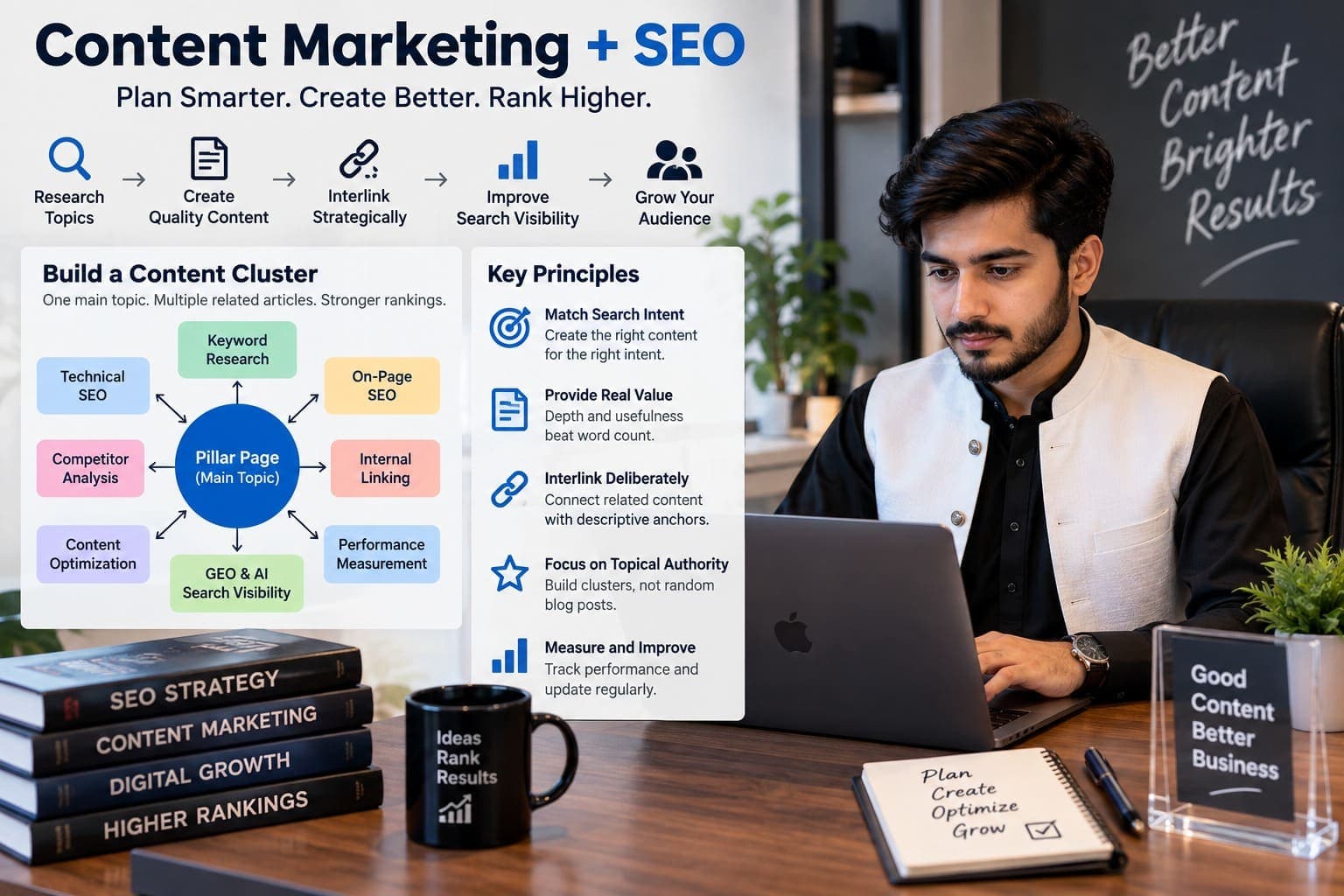
A broader content marketing strategy for SEO can help organize these topics into clusters instead of treating every article as an isolated page.
One of the most common mistakes in competitive SEO is treating every article as an isolated piece of content.
A stronger strategy connects related content and gives users a logical path through the website.
For example:
US SEO guide → Local SEO guide → City-specific page → Service page → Conversion page
Internal links should use descriptive anchor text and should only connect pages that are genuinely relevant to one another.
The objective is to create a website where related information supports other related pages rather than leaving articles isolated.
Traditional SEO focuses heavily on helping websites appear in search results.
AEO and GEO broaden the discussion to how information is structured, understood, and surfaced in AI-powered search experiences.
For US businesses, this can involve:
Answering customer questions clearly
Structuring information logically
Building topical authority
Maintaining accurate business information
Publishing authoritative content
Strengthening internal linking
Improving technical accessibility
Maintaining consistent business information
Businesses targeting AI-powered search can also explore Generative Engine Optimization (GEO).
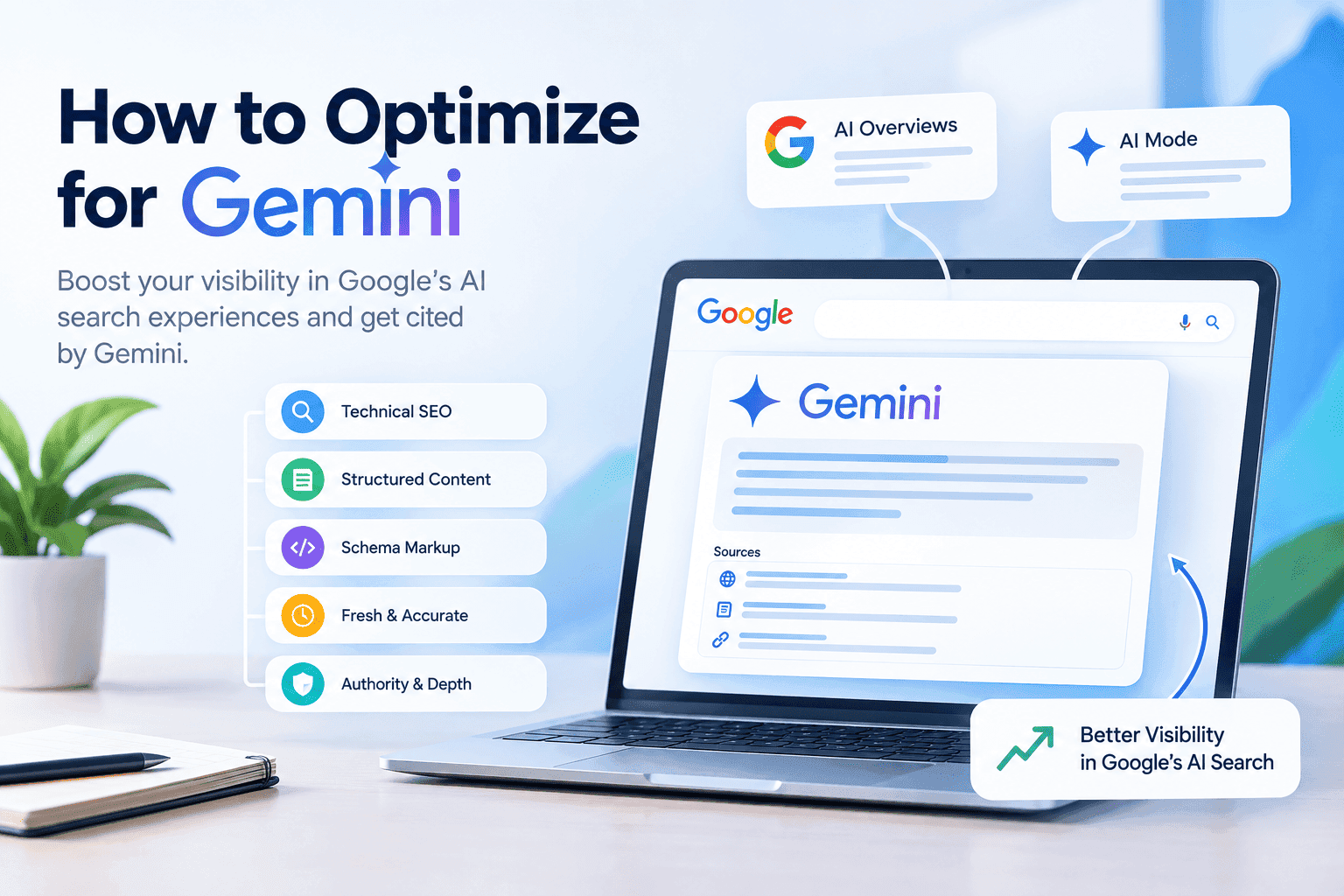
For businesses specifically interested in Google's AI search ecosystem, Gemini Search SEO is another relevant area to understand.
Search behavior is changing.
Customers can discover businesses through traditional Google results as well as AI-powered experiences.
That means a modern US SEO strategy can benefit from combining:
Technical SEO
Content strategy
Internal linking
Topical authority
Local SEO
AEO
GEO
Accurate business information
The goal is not to abandon traditional SEO.
Instead, businesses can build a strong technical and content foundation that supports visibility across multiple search experiences.
Watch for content that uses generic international terminology without understanding American customers.
For regulated or multi-state businesses, an agency should be able to explain how it handles differences between states.
If a company has multiple locations, reporting should make it possible to understand performance by location rather than showing only one national number.
If an agency claims to specialize in US SEO but cannot demonstrate relevant US-market experience, ask for more evidence before committing to a long-term campaign.
Don't judge an SEO campaign only by the number of articles published.
Track meaningful indicators such as:
Organic traffic
Keyword rankings
Search impressions
Search clicks
Leads
Conversion rate
Revenue where measurable
Local visibility
Indexed pages
Technical SEO health
For multi-location businesses, performance should also be analyzed by:
State
City
Location
Service area
Individual Google Business Profile
This gives a clearer picture of where the SEO strategy is actually producing results.
SEO for US businesses requires a strategy that reflects the competitiveness and diversity of the US search market.
Local businesses need location-focused strategies.
Multi-location businesses need scalable local systems.
National businesses need scalable topical authority and strong technical foundations.
Regulated industries may require additional state-specific considerations.
For businesses considering an international SEO partner, location should not be the only consideration.
Experience, transparency, communication, technical expertise, market-specific content, reporting, and an understanding of modern search should all be evaluated before making a decision.
For businesses looking for SEO support for the US market, RankNex AI's US digital marketing team provides SEO, PPC, AEO, GEO, and related digital marketing services for US businesses.
SEO for UK Businesses: Why Outsourcing to a Pakistan-Based Agency Works
Best SEO Company in Lahore for Local & International Businesses
Content Marketing for SEO: How to Build a Strategy That Actually Ranks
Gemini Search SEO: How to Get Your Business Recommended by Google's Gemini
What Is GEO (Generative Engine Optimization)? Complete 2026 Guide
Get a comprehensive SEO & AI visibility audit for your website with zero obligation.