Technical SEO Checklist 2026: Crawling, Indexing, Speed & Schema
October 13, 2026Read Post
Healthcare SEO means meeting Google's strictest trust standards. Here's how YMYL guidelines, E-E-A-T, and local search actually work for clinics and medical practices.
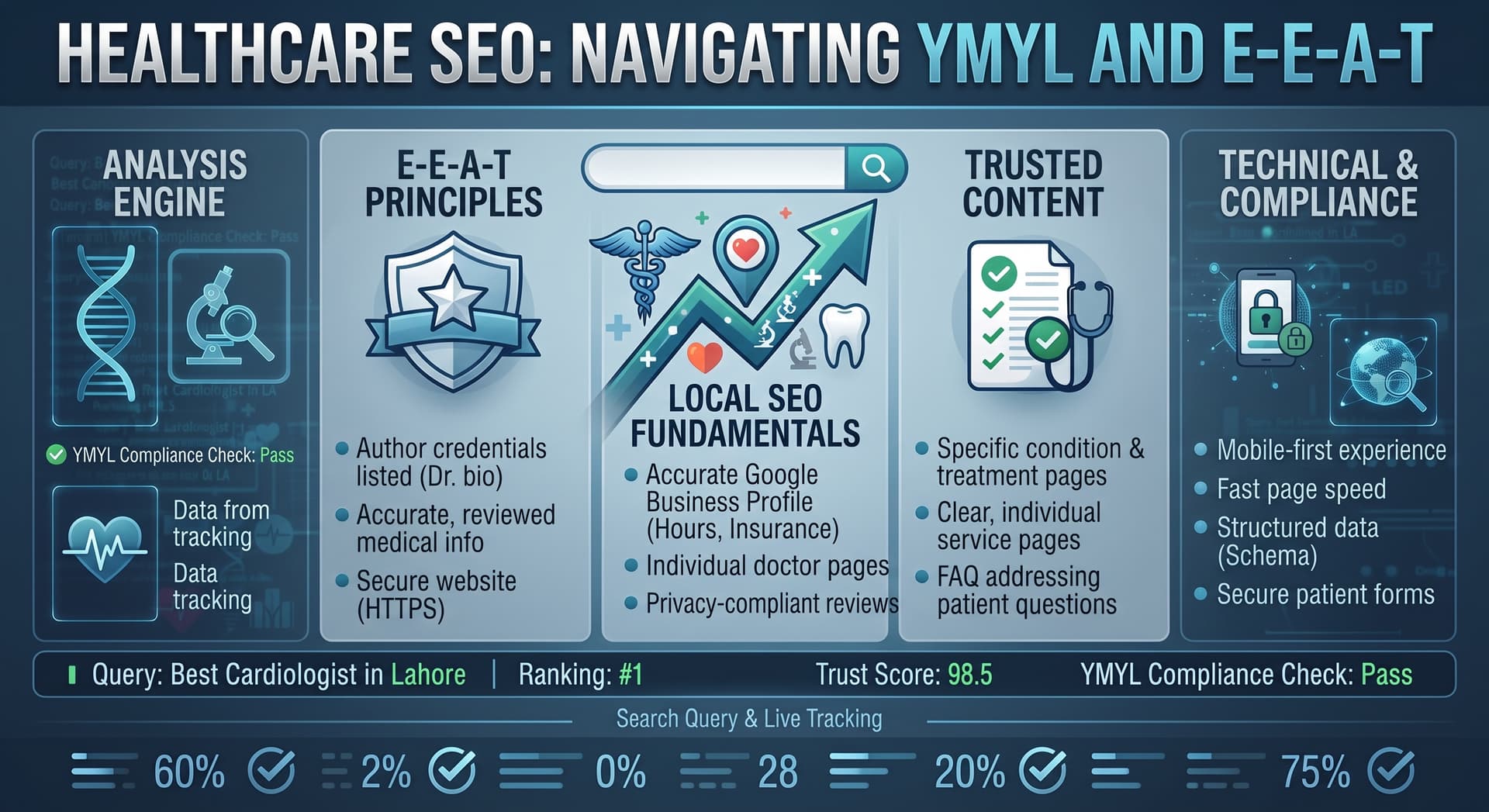
Healthcare sits at the center of what Google calls YMYL, "Your Money or Your Life," content, meaning it's held to a noticeably higher trust and accuracy bar than almost any other category. A clinic or medical practice can't approach SEO the way a retail store or local restaurant does. Here's what actually matters.
Content that could affect someone's health, safety, or financial wellbeing receives extra scrutiny from Google's quality systems. This means thin medical content, unverified claims, or pages without clear authorship and credentials are far more likely to be filtered out or ranked poorly, even if the same approach would work fine in a less sensitive industry.
E-E-A-T, Experience, Expertise, Authoritativeness, and Trustworthiness, is Google's framework for evaluating content quality, and healthcare is one of the categories where it's applied most rigorously:
Experience and Expertise. Content should be written or reviewed by qualified professionals, with clear author bios stating relevant credentials. A generic "admin" byline on medical content signals low trust.
Authoritativeness. A clinic or practice's broader reputation, citations from reputable health sources, professional affiliations, and consistent information across the web, contributes to how authoritative Google considers the domain.
Trustworthiness. Transparent information about practitioners, clear contact details, accurate licensing information, and secure, well-maintained website infrastructure all factor into trust signals for this category specifically.
Google Business Profile accuracy is critical. Specialties, accepted insurance (where applicable), hours, and location need to be precise. Healthcare searches often carry urgency, and incorrect information causes real friction for patients trying to get care.
Individual practitioner profiles matter. For multi-provider practices, each doctor or specialist often benefits from their own profile or page, since patients frequently search by specific provider name or specialty rather than just the clinic's brand name.
Reviews require careful, compliant handling. Patient reviews are a major trust signal, but healthcare businesses need to be mindful of privacy regulations when responding. Generic, non-specific responses that avoid confirming any patient relationship or health details are standard practice.
For more on location-based search visibility, see Local SEO in Lahore: How to Rank in Local Search Results.
Condition and treatment pages written with real medical accuracy. Content explaining conditions, symptoms, and treatment options needs to be accurate, current, and ideally reviewed by a qualified professional. This is exactly the type of content Google scrutinizes most closely under YMYL guidelines.
Clear, individual service pages. Each service or treatment offered deserves its own detailed page rather than being bundled into a vague general list. This helps both patients searching for a specific need and search engines understanding the practice's actual scope.
FAQ content addressing real patient questions. Common questions about procedures, recovery, costs, and what to expect are both genuinely helpful to patients and strong candidates for featured snippets and AI-generated search answers.
Author credentials displayed clearly. Every piece of medical content should clearly state who wrote or reviewed it, with relevant qualifications. This is one of the most direct E-E-A-T signals available.
Website security is non-negotiable. HTTPS, secure forms for any patient information, and general site security aren't just technical SEO boxes to check. They're trust signals Google weighs specifically for YMYL content.
Structured data for medical organizations and providers. Schema markup for medical organizations, individual practitioners, and services helps search engines understand and accurately represent the practice in search results.
Mobile experience matters for urgent searches. Many healthcare searches, especially for urgent care, emergency services, or same-day appointments, happen on mobile, often under time pressure, making fast load times and easy appointment booking critical.
For a broader approach to creating useful, trustworthy SEO content, see Content Marketing for SEO.
Thin or generic condition pages with no clear authorship or medical review
Missing or vague provider credentials across the site
Inconsistent information between the website, Google Business Profile, and insurance directories
Ignoring individual provider search demand by only optimizing for the practice's brand name
Outdated content on evolving medical topics, which both damages trust and accuracy
Healthcare SEO rewards practices willing to invest in genuine accuracy and credentialed content, not just keyword-optimized pages. Because Google holds this category to its highest trust standard, the practices that clearly demonstrate real expertise, qualified authorship, accurate information, transparent provider details, consistently outperform those that treat healthcare content like any other industry's SEO.
Restaurant SEO: The Complete Guide to Getting Found by Hungry Customers
Google Business Profile SEO: The Complete 2026 Guide
Website SEO Checker: How to Audit Any Website for Free
Get a Free Healthcare SEO Audit →
Get a comprehensive SEO & AI visibility audit for your website with zero obligation.