SEO for UK Businesses: Why Outsourcing to a Pakistan-Based Agency Works (2026)
September 23, 2026Read Post
Gemini is becoming closely connected with Google Search through AI Overviews and AI Mode, so optimizing for Gemini increasingly overlaps with traditional Google SEO. Businesses should focus on technical SEO, clear and structured content, relevant schema markup, accurate and fresh information, and strong topical authority. Unlike standalone AI platforms, Gemini's connection to Google's search ecosystem makes crawlability, indexing, rankings, and website structure especially important. However, ranking in Google does not automatically guarantee that Gemini will cite or recommend a website. To improve visibility, businesses should answer important questions directly, organize content with clear headings, maintain accurate information, use appropriate structured data, build interconnected topic clusters, and regularly test how their brand appears in Gemini and Google AI search experiences. The overall takeaway is that AI visibility and traditional SEO are increasingly converging, making strong SEO fundamentals an important foundation for appearing in Google's AI-powered search experiences.
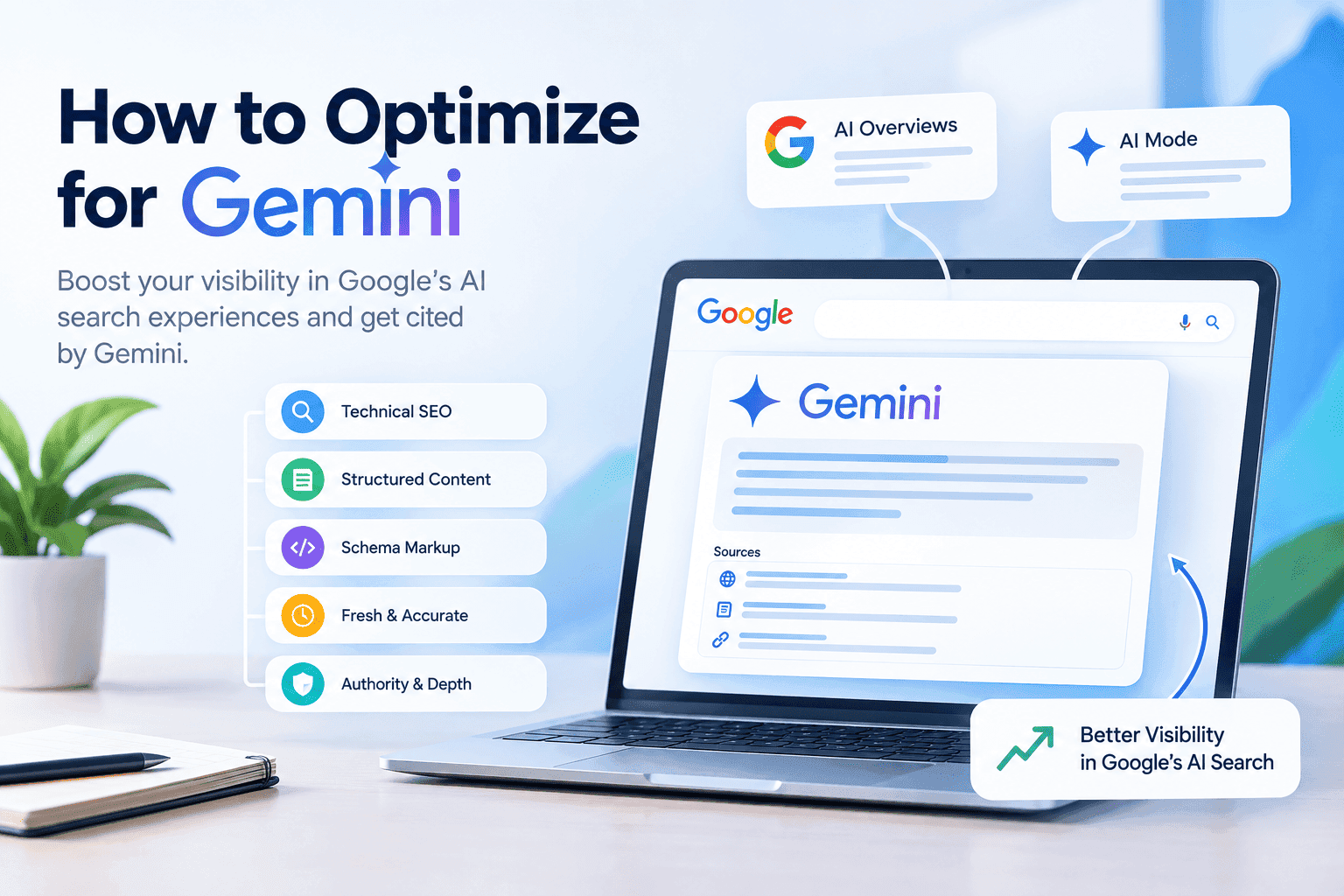
Gemini isn't just a standalone chatbot anymore — it increasingly sits underneath Google's own AI-driven search experiences, including AI Overviews and AI Mode. That means optimizing for Gemini isn't a completely separate side project from optimizing for Google; the two are increasingly connected. Here's what that actually means for your content.
People use Gemini in two distinct ways: directly, as a standalone AI assistant through the Gemini app or embedded in Google Workspace, and indirectly, through Google's AI-powered search experiences such as AI Overviews and AI Mode.
These different experiences can surface information from web sources, which means businesses need to think beyond traditional rankings. The goal is not simply to rank a page for a keyword, but to make the information on that page clear, useful, trustworthy, and easy for search and AI systems to interpret.
For businesses working on broader AI visibility optimization, this means combining traditional SEO fundamentals with content structures that make important information easy for AI systems to understand and retrieve.
While the underlying goal — being surfaced as a trustworthy and relevant source — is similar across generative AI tools, Gemini has an important distinction: its close relationship with Google's search ecosystem.
This makes traditional SEO fundamentals particularly important when you're trying to improve visibility across Google-powered AI experiences. Crawlability, indexing, content quality, relevance, internal linking, structured data, and overall website authority all remain important parts of the equation.
However, ranking highly in Google does not automatically guarantee that a page will be cited or referenced in every Gemini response. AI-generated results depend on the specific query, available sources, relevance, freshness, and other systems involved in generating the response.
In other words, Google SEO and Gemini optimization overlap significantly, but they are not exactly the same thing.
Because Gemini-powered Google Search experiences are closely connected to Google's search ecosystem, a page needs strong technical foundations.
A page that cannot be crawled or indexed has limited opportunity to appear in search-driven experiences. Technical SEO problems such as blocked crawling, incorrect canonicalization, indexing errors, broken internal links, or poor site architecture can therefore limit visibility.
Before focusing heavily on AI optimization, make sure your important pages can be discovered, crawled, indexed, and understood by search engines.
Generative AI systems need to interpret information before they can summarize or reference it.
Content that provides a clear answer early and then expands with supporting information is generally easier to understand than a page where the answer is buried inside several paragraphs.
Use:
Clear H2 and H3 headings
Short, focused paragraphs
Direct answers to important questions
Lists and tables where appropriate
Definitions for industry-specific terminology
Descriptive page titles
Relevant supporting examples
Clearly separated sections
For example, instead of beginning an article with several paragraphs of background information, answer the primary question first and then provide the explanation underneath it.
Structured data gives search engines machine-readable information about the content and entities represented on a page.
Depending on the page, relevant schema can include:
Article
Organization
BreadcrumbList
Product
LocalBusiness
FAQPage, where appropriate and supported by the page's actual content
Schema should accurately describe the page rather than being added simply to increase the amount of markup.
It is also important to remember that structured data does not guarantee that Google or Gemini will display or cite a page. Its purpose is to help systems understand the information represented on the page.
AI-powered search experiences can surface information that is more current than what a static language model may have learned during training.
That makes content maintenance increasingly important.
Review important pages periodically and update:
Statistics
Dates
Product information
Pricing
Industry developments
Regulations
Examples
Screenshots
References
Outdated claims
Do not change information simply to make a page appear "fresh." Updates should reflect genuine improvements, corrections, or changes to the subject.
A single strong article can perform well, but a website with multiple useful resources covering a subject in depth can provide stronger contextual signals.
Build related content around important topics instead of publishing disconnected articles.
For example, a website targeting AI search visibility could create supporting content covering:
AI search optimization
Google AI Overviews
Gemini optimization
ChatGPT SEO
Generative Engine Optimization
AI citations
Entity optimization
Structured content
Brand visibility in AI search
Then connect those pages with relevant internal links.
For a deeper explanation of this approach, see What Is GEO (Generative Engine Optimization)? Complete 2026 Guide.
This creates a content ecosystem rather than a collection of isolated articles.
Given Gemini's close relationship with Google Search, unresolved indexing or crawlability issues can limit visibility in search-driven AI experiences.
Check:
Robots.txt
XML sitemap
Indexing status
Canonical tags
Internal links
Mobile usability
Page speed
HTTPS
Broken pages
Redirects
JavaScript rendering
Duplicate content
Technical SEO should form the foundation before you invest heavily in AI-specific optimization.
If you're reviewing the technical condition of a website, a website SEO checker and audit can help identify common technical and on-page issues.
Identify the primary question the page is intended to answer.
Then provide a concise answer near the beginning of the page before expanding into supporting detail.
A strong structure might look like:
Question → Direct Answer → Explanation → Evidence → Examples → Related Questions
This makes the page easier for both humans and automated systems to navigate.
Avoid turning a page into one large block of text.
Instead, organize information logically with descriptive headings.
For example:
What Is Gemini SEO?
How Does Gemini Find Information?
What Factors Affect AI Visibility?
How Do You Optimize Content?
How Can You Measure Visibility?
Descriptive headings provide context for the content that follows them.
Add structured data where it genuinely applies.
For example, an article can use Article schema, while a business website may use Organization or LocalBusiness schema depending on the entity and page.
Make sure the information in your schema matches the visible content on the page.
Create a content-maintenance schedule for pages that target fast-changing subjects.
A page about AI search optimization may need more frequent review than an evergreen page about a historical topic.
When updating a page, focus on meaningful improvements rather than simply changing the publication date.
Create supporting content around your primary topic and connect related pages through contextual internal links.
For example, a website targeting AI visibility could connect a Gemini optimization guide with articles about Google AI Overviews, ChatGPT SEO, and GEO.
This helps users discover related information while giving search engines additional context about the site's topical coverage.
For more information about how generative engines interpret and retrieve content, see the GEO guide.
Gemini optimization should not be treated as an isolated tactic.
Businesses that want to improve how their brand is understood and surfaced across AI-powered search systems can combine traditional SEO, structured content, entity signals, authoritative references, and broader AI visibility optimization.
The objective is to build a website that is easy for both search engines and AI systems to understand — while still providing a useful experience for human visitors.
One practical way to monitor visibility is to search for the questions your potential customers are likely to ask.
Test queries such as:
"What are the best [service] companies in [location]?"
"Who provides [service] for [type of customer]?"
"What is the best solution for [problem]?"
"How does [product/service] compare with alternatives?"
"Which companies specialize in [specific service]?"
Then check whether your brand appears and whether the information presented about your business is accurate.
You can also test variations of the same query because AI-generated responses can change depending on wording, location, freshness, available sources, and other contextual factors.
Because Google's AI-powered search experiences and Gemini capabilities continue to evolve, a single test should not be treated as a permanent visibility measurement.
Track your visibility periodically instead.
Instead of focusing only on whether your brand appears once, monitor several signals over time.
These can include:
Whether your brand is mentioned
Which pages are referenced
Whether your business information is accurate
Which competitors appear alongside you
Which questions trigger your brand
Whether third-party sources mention your business
Whether important pages remain indexed
Organic search performance
Branded search visibility
Referral traffic from AI platforms where measurable
This provides a broader picture than checking one Gemini response.
The clearest takeaway for anyone optimizing for Gemini is that it is less a completely separate discipline and more an extension of strong search optimization combined with content practices that help generative AI systems interpret information.
Traditional SEO still matters.
Technical accessibility matters.
Content quality matters.
Clear structure matters.
Authority and relevance matter.
Freshness matters.
Structured data can also help search engines understand the entities and information represented on a page.
However, none of these elements should be treated as a guaranteed formula for appearing in Gemini or Google's AI-generated results.
AI search systems can select different sources for different queries, and the systems behind these experiences continue to change.
Gemini's close integration with Google's search ecosystem means the distinction between traditional search visibility and AI visibility is becoming increasingly interconnected.
The practical approach is not to abandon SEO in favor of a separate "Gemini trick."
Instead, build technically accessible websites, create accurate and well-structured content, establish topical depth, use appropriate structured data, maintain important pages, and develop a broader AI visibility optimization strategy.
The businesses that consistently make their information easy to discover, understand, verify, and reference are better positioned to participate in the evolving AI-search ecosystem.
Get a comprehensive SEO & AI visibility audit for your website with zero obligation.