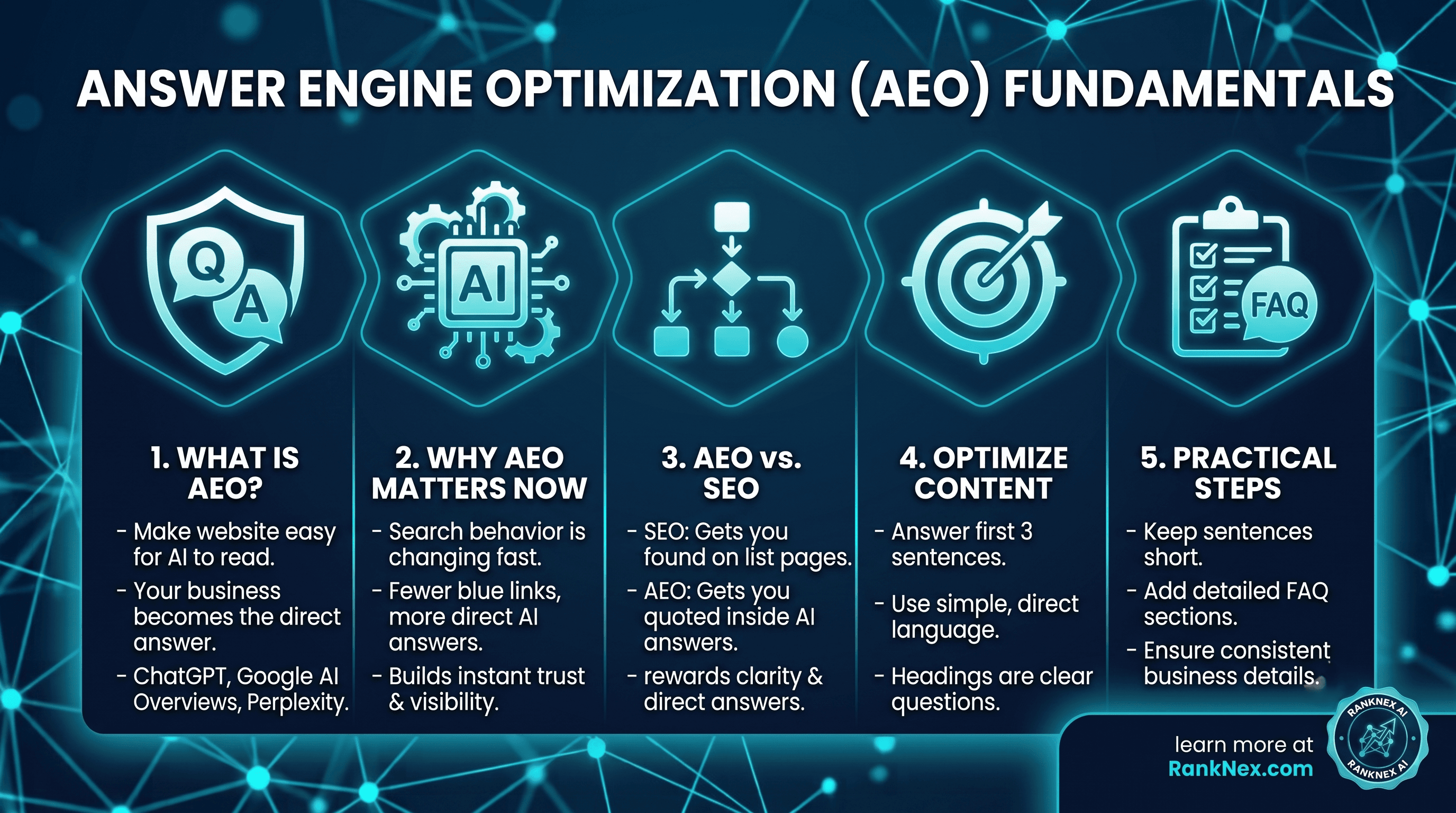
AEO stands for Answer Engine Optimization. In simple words, it means making your website easy for AI tools like ChatGPT, Google AI Overviews, and Perplexity to read, understand, and use as an answer. When someone asks a question and the AI picks your business as part of its answer, that is AEO working for you.
This guide explains what AEO actually means, why it matters right now, and what you can do about it, without any confusing technical language.
What Does AEO Mean in Simple Words
Think about how people search today. A few years ago, someone would type "best plumber near me" into Google and get a list of ten websites to click through. Now, more and more people just ask ChatGPT or Google's AI Overview the same question and expect one clear answer.
AEO, short for answer engine optimization, is the practice of writing and structuring your website content so that AI tools can pick it up and use it in that answer. Instead of just trying to rank number one on a page of blue links, you are trying to become the answer itself.
Why AEO Matters for Your Business
Search behavior is changing fast. A growing share of questions people used to type into Google are now being asked directly to AI chat tools. If your business is not set up for AEO, you simply will not exist in those answers, even if you rank well in normal Google search.
Here is why this matters for a small or medium business specifically.
Most competitors have not done this yet. Large enterprise agencies talk about AEO in complicated terms, which means very few small businesses have actually applied it.
That gives you a real chance to get ahead early, the same way early SEO adopters got ahead of their competitors years ago.
Being mentioned by an AI tool builds trust instantly. When ChatGPT or Google AI recommends your business by name, the person asking already trusts that answer. That trust is worth more than a normal search click.
It costs nothing extra to prepare for. AEO is not a separate paid tool or subscription. It is mostly about how you write and organize the content you already have.
How Is AEO Different From SEO
SEO and answer engine optimization work together, but they are not the same thing.
SEO focuses on ranking your page higher in a list of search results. The goal is to get more clicks to your website. It rewards technical setup, backlinks, and keyword relevance built up over time.
AEO focuses on getting your actual information picked and quoted directly inside an AI generated answer. The goal is to become the trusted source, even if the person never clicks through to your site. It rewards clarity, directness, and content that reads like a genuine answer rather than a sales pitch.
A simple way to remember it is this. SEO gets you found. AEO gets you quoted.
The good news is that a page built well for AEO usually helps your normal SEO too, since both reward clear, honest, well organized content. You are not choosing between the two, you are building one strong page that satisfies both at once.
How AI Answer Engines Choose What to Show
AI tools like ChatGPT, Perplexity, and Google AI Overviews do not choose answers randomly. They look for content that is easy to understand, clearly organized, and directly answers a real question. A few things they consistently prefer include the following.
Content that answers the question in the first two or three sentences, instead of making the reader scroll for it.
Clear headings that are written as real questions, the same way a person would type them.
Simple, direct language instead of long, complicated sentences.
Information backed by real facts, numbers, or examples instead of vague claims.
Pages that are technically clean, meaning fast loading, mobile friendly, and properly structured.
How Can You Start With AEO Today
You do not need a big budget to start. Here are practical steps any small business can take this month.
Write your page content so the first sentence under each heading directly answers that heading. Do not save the answer for later in the paragraph.
Turn your headings into real questions your customers actually ask, such as "How much does this cost" or "How long does this take."
Keep sentences short and avoid industry jargon that a normal customer would not use in daily conversation.
Add a simple FAQ section to your important pages, since AI tools frequently pull answers directly from FAQs.
Make sure your business name, services, and location are stated clearly and consistently across your website, since AI tools rely on that consistency to trust your information.
If you want a professional setup instead of doing this alone, our AEO and AI search optimization service covers all of this for you from the technical side to the content itself.
What Mistakes Do Businesses Make With AEO
Many businesses either ignore AEO completely or overcomplicate it.
A few common mistakes to avoid include writing long introductions before getting to the actual answer, and using vague marketing language instead of specific facts.
Other frequent mistakes include ignoring mobile users and treating AEO as a one time task instead of an ongoing habit.
Many businesses also never check whether they actually show up when a real customer asks an AI tool a question. You can run that exact check yourself using the steps in our guide on checking your ChatGPT visibility.
A Simple Example
Imagine a small bakery in London. Someone asks ChatGPT, "what is the best bakery near me for custom birthday cakes."
If that bakery's website clearly states its location, its custom cake service, its pricing range, and answers common questions like "how far in advance do I need to order," the AI has everything it needs to confidently recommend that bakery by name.
Now imagine a competing bakery whose website only has a photo gallery and a short "about us" paragraph with no clear answers. The AI has nothing solid to quote, so it skips that bakery entirely, even if their cakes are just as good.
This is the real difference AEO makes. It is not about tricking an algorithm. It is about giving AI tools, and your customers, the clear answers they are already looking for.
Frequently Asked Questions
What does AEO stand for?
AEO stands for Answer Engine Optimization, the practice of structuring your website content so AI tools like ChatGPT and Google AI Overviews can use it directly as an answer.
Is AEO for small business owners worth the effort?
Yes. Most small businesses have not started yet, which means the ones who apply AEO for small business content now have a real head start before it becomes standard practice.
How is AEO different from SEO?
SEO focuses on ranking your website in a list of search results. AEO focuses on getting your actual information quoted directly inside an AI generated answer, even if the person never clicks through to your site.
How long does it take to see results from AEO?
Since AEO relies on clear, well structured content rather than technical changes alone, many businesses start seeing their information picked up in AI answers within a few weeks of publishing properly optimized pages, with stronger results building over a few months.
Final Thoughts
AEO is not a trend you can afford to wait out. As more people ask questions directly to AI tools instead of typing them into a search bar, businesses that prepare their content now will be the ones showing up in those answers later.
The good part is that getting started does not require a complicated strategy, just clear, honest, well organized content that answers real questions.
If you want to know exactly where your business currently stands with AI search visibility, RankNex AI offers a free SEO and AEO` audit that shows you precisely what to fix first.