E-commerce SEO: The Complete Guide to Ranking an Online Store (2026)
September 30, 2026Read Post
SaaS SEO requires a strategy built around a longer and more complex buyer journey. Unlike many industries, SaaS companies often compete for highly valuable keywords while relying on free trials, demos, and multiple decision-makers. A strong SaaS SEO strategy should cover the entire funnel. Comparison and alternative pages target users close to making a decision, while use-case and solution pages address specific problems. Educational content builds awareness, authority, and backlinks, while individual product and feature pages capture more specific searches. SaaS businesses should also focus on alternative and comparison keywords, integration searches, and problem-aware queries. Technical SEO is equally important, including site speed, indexability, documentation, and structured data. For link building, original research, digital PR, expert contributions, and genuine integration partnerships can help build authority. Success should ultimately be measured by organic-driven trial signups, demo requests, and paid conversions, not just traffic or rankings. Overall, SaaS SEO works best when content, technical SEO, link building, and AI search visibility are connected to the actual buyer journey.
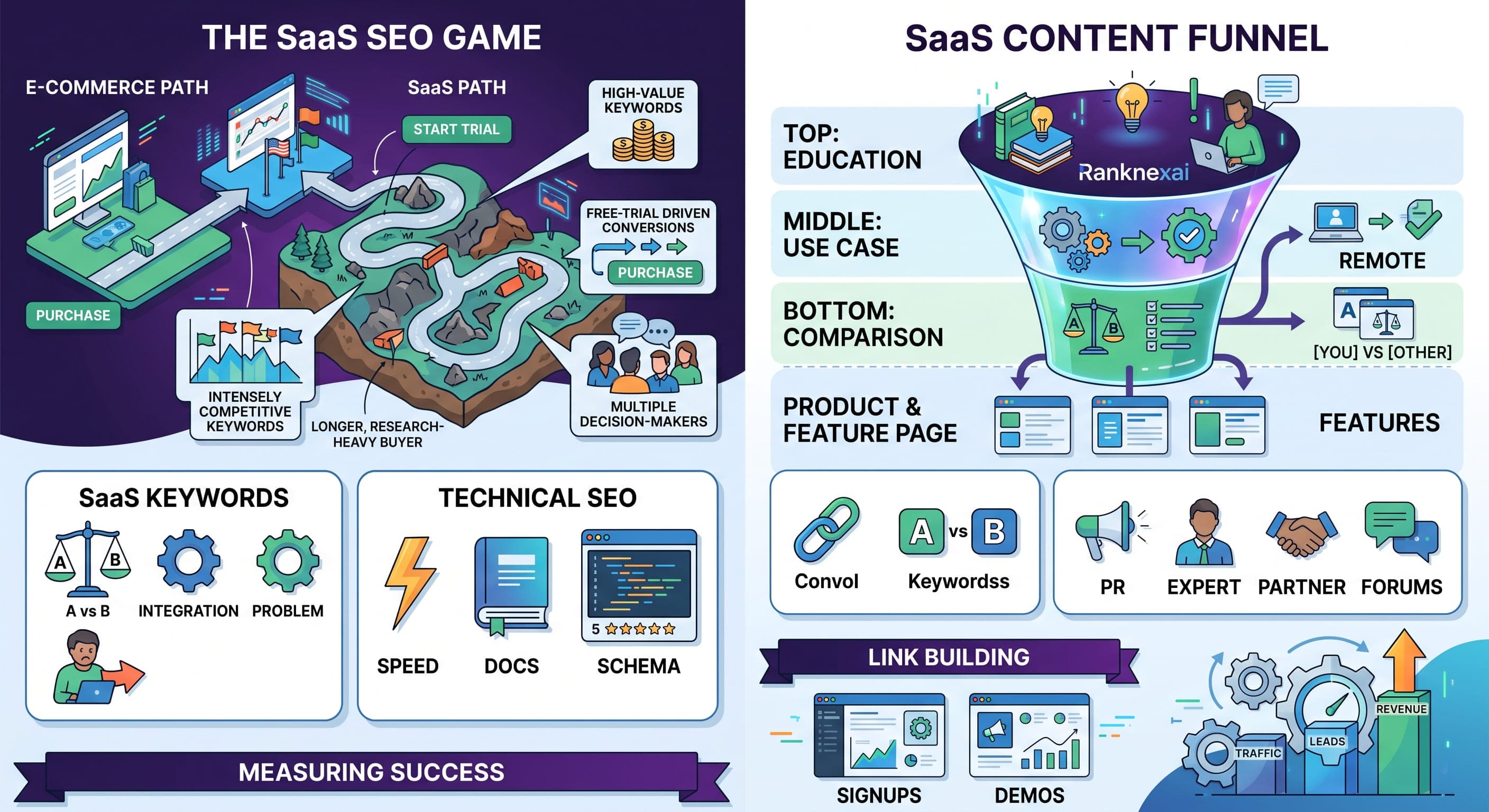
SaaS SEO looks deceptively similar to any other industry's SEO from the outside, content, keywords, backlinks. In practice, it's shaped by a few things most industries don't deal with at the same intensity: intensely competitive, high-value keywords, free-trial-driven conversion paths, and a buying cycle that often involves multiple people before a purchase decision is made. Here's how to approach it properly.
Keyword competition is fierce and well-funded. SaaS categories tend to attract venture-backed competitors with large content and SEO budgets, meaning the keywords that matter most are often the hardest to rank for. A realistic SaaS SEO strategy has to account for this rather than assuming effort alone closes the gap quickly.
The buyer journey is longer and more research-heavy. B2B SaaS purchases often involve multiple stakeholders and a research phase that spans weeks or months, which means content needs to address several distinct stages, awareness, comparison, and decision, not just a single high-intent keyword.
Free trials and demos change what "conversion" means. Unlike e-commerce, the goal usually isn't an immediate purchase but a signup, trial start, or demo request, content and page structure need to be built around that different kind of conversion action.
Bottom-of-funnel: comparison and alternative pages. Content like "[Your Product] vs [Competitor]" or "[Competitor] Alternatives" captures people actively comparing solutions, often the highest-converting content type in SaaS SEO, since it reaches people very close to a decision.
Middle-of-funnel: use case and solution pages. Pages built around a specific problem or use case ("project management for remote teams," "invoicing software for freelancers") capture searchers who know their problem but haven't settled on a specific product yet.
Top-of-funnel: educational content. Broader guides and how-to content build awareness and backlinks, even if they don't convert directly, they bring in an audience who may convert later or share the content with others who will.
Product and feature pages optimized individually. Each major feature deserves its own well-optimized page rather than being buried in a single long features list, this captures more specific, often lower-competition searches related to that particular capability.
Beyond standard keyword research, SaaS businesses should pay particular attention to:
"Alternative" and "vs" keywords around established competitors, which tend to have strong commercial intent
Integration-related keywords ("[Your Product] + [popular tool] integration"), which capture users already in another tool's ecosystem
Problem-aware keywords that describe the pain point rather than the solution category, since not every searcher knows the right category name yet
Site speed matters even more for credibility. A software company with a slow website undermines its own pitch, performance issues read as a direct contradiction of the product being sold.
Help center and documentation content is an SEO asset, not just support material. Public-facing help docs often rank well for highly specific, long-tail queries and can drive meaningful organic traffic while serving existing customers simultaneously.
Structured data for software products. SoftwareApplication schema and review/rating markup can improve how listings appear in search results, particularly for product and pricing pages.
If important SaaS pages are not appearing in Google, technical issues should be checked before scaling content. See Why Your Pages Aren't Getting Indexed on Google for common indexing problems and possible fixes.
Digital PR around original data or research tends to perform exceptionally well in SaaS, since industry publications and other SaaS blogs frequently cite original survey data, benchmarks, or product usage statistics.
Guest contributions and expert commentary in industry publications build authority in a space where thought leadership carries real weight with both readers and search engines.
Integration partner link exchanges (when genuine, not purely transactional) with complementary tools in your ecosystem are a natural, relevant source of backlinks.
Traffic and rankings are leading indicators, but the metrics that matter to the business are trial signups, demo requests, and ultimately paid conversions attributable to organic search. Tracking which content types and keywords actually drive signups, not just visits, shows where to double down.
SaaS companies need content that supports different stages of the buyer journey rather than publishing unrelated articles. Comparison pages, use case content, educational guides, product content, and supporting resources should work together as a connected system.
A structured Content Marketing for SEO strategy can help SaaS businesses organize topic clusters, match content with search intent, and use relevant internal links to connect supporting articles with important commercial pages.
SaaS businesses are also competing for visibility in AI-powered search experiences. Clear content structure, strong topical authority, useful answers, technical SEO, and connected content can all contribute to how information is understood by modern search systems.
For businesses exploring AI search visibility, Gemini Search SEO explains how traditional SEO fundamentals connect with Google's AI-powered search experiences.
Generative Engine Optimization (GEO) is another relevant area for SaaS brands that want their content to be understood and surfaced across generative AI systems.
SaaS SEO rewards a strategy built around the actual buyer journey, comparison and alternative content for bottom-of-funnel intent, use-case content for the messy middle, and genuine educational content to build authority and reach. Competing purely on volume against well-funded competitors rarely works; winning specific, well-chosen battles across the funnel consistently does.
Content Marketing for SEO: How to Build a Strategy That Actually Ranks
How to Find Keywords Your Competitors Are Ranking For
E-commerce SEO: The Complete Guide to Ranking an Online Store
Get a Free SaaS SEO Audit →
Get a comprehensive SEO & AI visibility audit for your website with zero obligation.