Local SEO Case Study: 513 Phone Calls from Google Business Profile
August 31, 2026Read Post
SEO gets you ranked. GEO gets you cited inside AI answers. Here's how they differ and how to prepare your content for both in 2026.
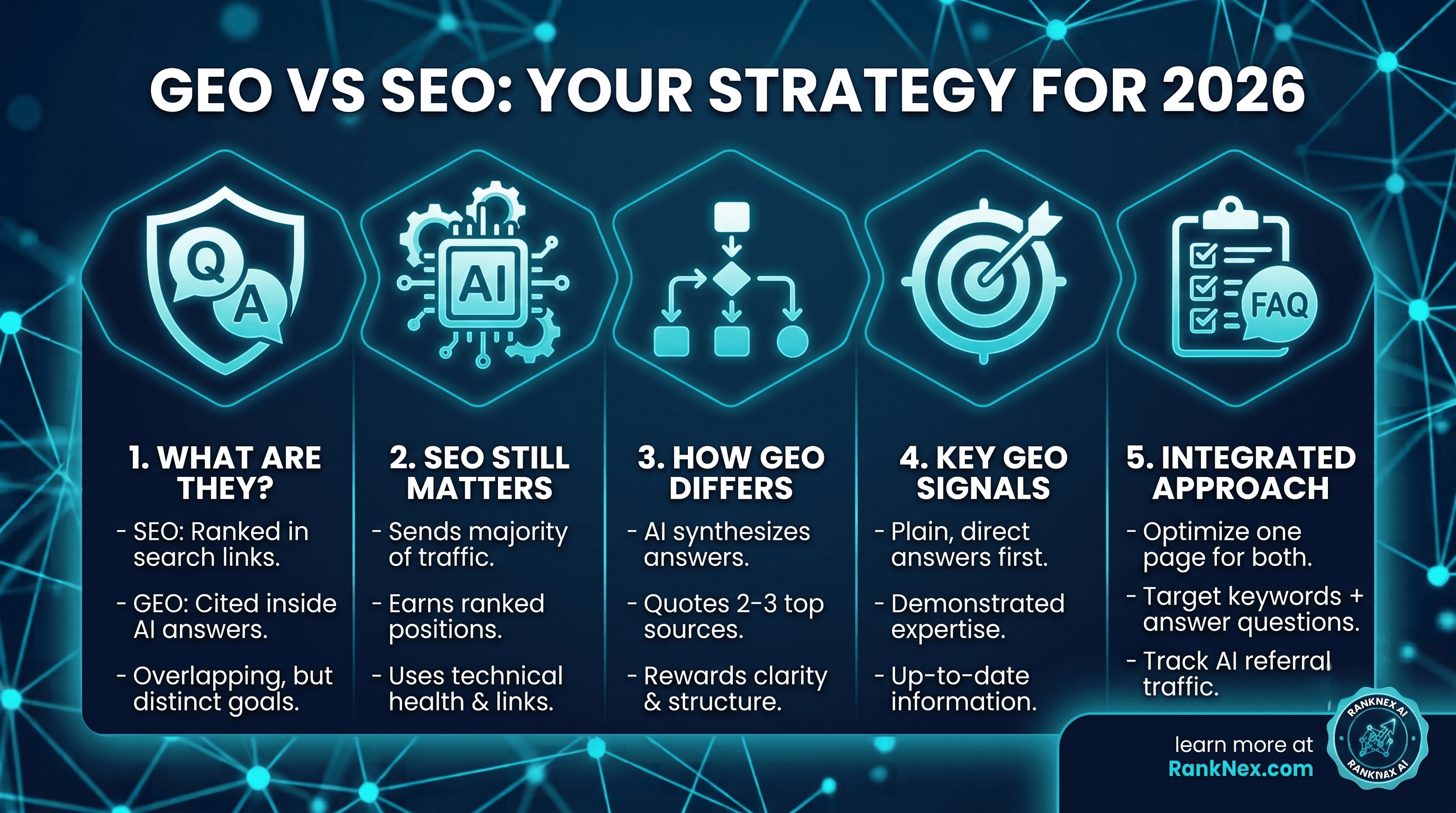
If you've spent any time researching search marketing recently, you've probably run into two acronyms that get used almost interchangeably: SEO and GEO. They are not the same thing, and treating them as identical is the fastest way to miss half the opportunity in front of you.
SEO (Search Engine Optimization) is about ranking in the traditional list of blue links on Google, Bing, or similar search engines. GEO (Generative Engine Optimization) is about being cited or summarized inside AI generated answers — Google's AI Overviews, Gemini responses, and similar generative search experiences. Both matter. They require overlapping but distinct approaches.
Traditional SEO earns you a ranked position on a results page. The searcher sees your title, your meta description, and your URL, and decides whether to click through to your site. Rankings are earned through technical health, relevant content, and backlinks, factors that have driven search visibility for two decades.
SEO still sends the majority of organic traffic to most websites, and that isn't changing overnight. But it's no longer the only channel that matters.
Generative Engine Optimization is about how your content gets used, not just how it gets ranked. When someone asks Google's AI Overview or Gemini a question, the system doesn't just list ten links. It synthesizes an answer, often citing two or three sources directly in that answer.
Getting picked as one of those sources depends on different signals than classic ranking factors:
Clear, direct answers. Generative systems favor content that states a fact or answer plainly, early in the page, rather than building up to it.
Structured content. Headings, lists, and well organized sections make it easier for an AI system to extract a clean answer.
Demonstrated expertise. Content that shows real experience and specificity, not generic filler, is more likely to be trusted as a source.
Up to date information. Generative systems tend to favor content that reflects current facts, so outdated pages get skipped even if they still rank in traditional search.
A page can rank well in traditional search and still never get pulled into an AI generated answer. The reverse is also true. A well structured FAQ page might get cited by an AI Overview without ranking particularly high in blue link search. Because both surfaces send real traffic and real visibility, the smartest approach treats them as one integrated strategy rather than two competing projects.
In practice, that means writing content that:
Targets a specific, well researched keyword (for traditional SEO)
Answers the core question clearly within the first few sentences (for GEO)
Uses proper heading structure and supporting detail (for both)
Is backed by genuine expertise rather than surface level summary
You don't need to abandon your existing SEO work to prepare for generative search. Start with these steps:
Audit your top pages for whether they answer their target question directly, or whether the reader has to read several paragraphs before getting a clear answer.
Add FAQ sections to service and product pages, written in plain language that mirrors how people actually ask questions.
Check your entity signals. Make sure your business name, location, and services are described consistently across your website, so AI systems can confidently identify who you are and what you do.
Track AI referral traffic where possible, in addition to standard organic traffic, so you can see which content is actually getting picked up in AI answers.
Search is splitting into two overlapping surfaces: traditional results and generative answers. Businesses that treat GEO as an afterthought will keep showing up in the old list while their competitors get quoted directly in the new one. The businesses that adapt early, restructuring content for clarity and answer first writing, get a visibility advantage before it becomes standard practice.
Is GEO replacing SEO?
No. GEO is an additional layer on top of SEO, not a replacement for it. Traditional search results still drive significant traffic, and the technical and content fundamentals of SEO remain the foundation GEO is built on.
Do I need separate content for GEO and SEO?
Not usually. The same page can perform well in both if it's structured with clear, direct answers and solid technical SEO underneath it. Very few businesses need a completely separate content strategy for each.
How do I know if my content is being used in AI answers?
There's no single universal tool yet, but you can test manually by asking Gemini or Google's AI Overview questions your content is meant to answer, and checking whether your business is mentioned or cited.
At RankNex AI, we build SEO strategies that cover both traditional rankings and AI generated answers as one integrated plan. If you want to see where your site currently stands, get a free audit a look at our SEO services.